
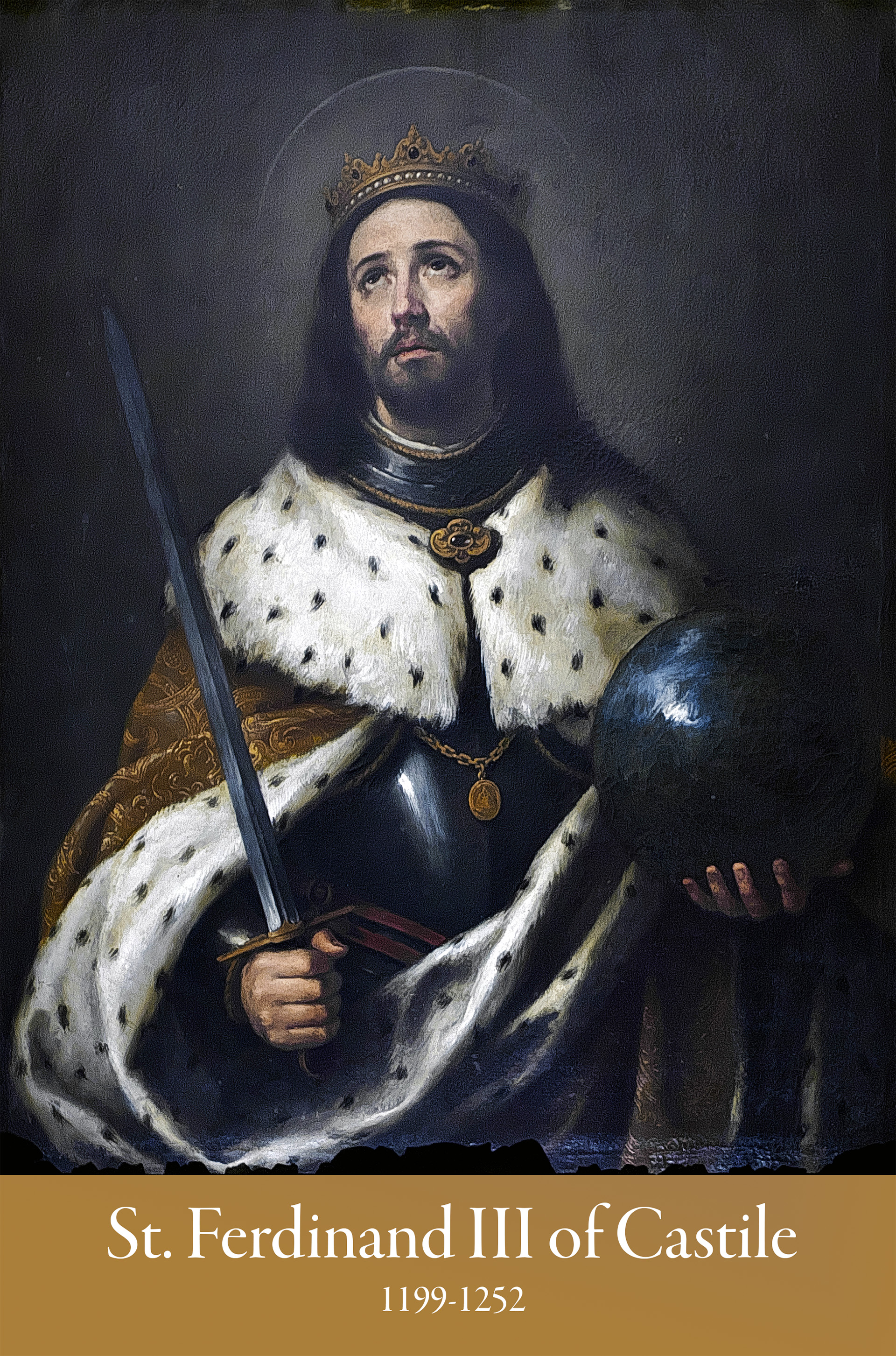
In our last article, we shared how Saint Ferdinand’s Academy began. But why did we choose Saint Ferdinand III of Castile (1199–1252) as our patron? As we celebrate his feast day each year on May 30, his life offers a compelling example of the faith, courage, and character we hope to cultivate in our students.
“Fear, love and obey God and join your will and deeds with Him.”— Saint Ferdinand III, in counsel to his son Alfonso
Saint Ferdinand III was one of the greatest kings of medieval Spain. He was born to Alfonso IX, King of León, and Berengaria, the eldest daughter of Alfonso VIII, King of Castile. Through his mother, he was related to the royal houses of England and France. His maternal grandmother was a daughter of Henry II of England, and his aunt Blanche was the mother of Saint Louis IX, King of France.
In 1217, upon the death of her brother Henry, Berengaria inherited the crown of Castile. She soon renounced her rights in favor of her son Ferdinand, who was then eighteen years old. Two years later, Ferdinand married Beatrice, daughter of Philip of Swabia. They had seven sons and three daughters.
Ferdinand proved himself a wise and capable ruler. He administered justice firmly but was always ready to forgive personal injuries. Much of his success was due to his ability to choose good men for positions of responsibility. Among his closest advisers was Rodrigo Jiménez de Rada, Archbishop of Toledo, who served as chancellor of Castile for many years.
When Alfonso IX died in 1230, Ferdinand succeeded him as King of León. His right to the throne was contested by those who favored the claims of his two half-sisters, but he eventually secured the succession and united León and Castile under his crown. He also encouraged learning and contributed greatly to the development of the University of Salamanca, which became one of the most renowned centers of education in Spain.
It was, however, through his campaigns against the Moors that Ferdinand earned his lasting place in Spanish history. For twenty-seven years he was engaged in almost continuous warfare, recovering large territories that had been under Muslim rule. He took Úbeda in 1234, Córdoba in 1236, and subsequently Murcia, Jaén, Cádiz, and Seville, which fell to him in 1248. These victories greatly strengthened the Christian kingdoms of Spain.
At the Battle of Jerez, according to an old tradition, Saint James the Apostle appeared on a white horse and led the Christian army to victory. In thanksgiving for his successes, Ferdinand undertook the rebuilding of the Cathedral of Burgos and converted the great mosque of Seville into a Christian church.
Despite his military achievements, Ferdinand was remembered not only as a conqueror but also as a merciful ruler. He was careful in the administration of justice and showed particular concern for the weak. It was said of him that he feared the curse of a single old woman more than an entire army of Moors. His wars were regarded by his supporters not merely as campaigns of conquest, but as efforts to free Christians living under Muslim dominion.

“I fear the curse of one poor old woman more than the whole army of the Moors.” — Saint Ferdinand III of Castile
After the death of Queen Beatrice, Ferdinand married Joan of Ponthieu. They had three children, among them Eleanor, who later became the wife of Edward I, King of England.
Ferdinand died on May 30, 1252, and was buried in the Cathedral of Seville, wearing the habit of the Friars Minor. His life of faith, his devotion to the Church, and his services to his people were recognized when Pope Clement X canonized him in 1671.
Saint Ferdinand is remembered as a king who united courage in war with justice, mercy, and deep religious conviction. His reign left a lasting mark on the history of Spain, and his example remains that of a ruler who sought to fulfill his duties in the service of God and his people. Saint Ferdinand is the patron of rulers, engineers, and those who build what endures.
We could think of no better model for the men we intend to form.
Interested in Saint Ferdinand’s Academy? Contact us to receive updates.
Support our mission to help bring faithful Catholic education to the next generation.
For inquiries about Saint Ferdinand’s Academy, please contact info@stferdinand.org